Welcome to The Creatrix.
Shame vs. Responsibility: Untangling People-Pleasing and Reclaiming Self-Trust
Dawn Cannon | JUL 7, 2025
At a pivotal point in my career, I was serving as the Chief Operating Officer of a national bank. I had made it clear during the hiring process that, as a single mother, frequent travel wasn’t something I could commit to. And yet, each time a leadership or client meeting arose out of town, I felt that familiar pull—tight in my chest, heavy in my belly. My body would whisper, Stay home. Be with your children. But my mind, driven by a deep need to prove my worth, would shout louder: A responsible COO shows up. A responsible leader sacrifices. A responsible woman figures it out.
So I did what many of us have done: I overrode my body’s truth and said yes. I told myself it was because I cared so deeply about the team, about the mission, about doing things “right.” And in part, that was true. But later, in the quiet unraveling that healing often requires, I saw what was beneath the over-functioning: shame.
The truth was, I wasn’t just showing up out of commitment. I was showing up because I feared what it would mean about me if I didn’t. Deep down, I believed I had to prove my value to avoid disappointing others or being seen as selfish or uncommitted. It wasn’t my organization that was pressuring me—it was the internalized shame that told me my needs were less important than my role. That my worth was measured by how much I could sacrifice.
At the time, I called it responsibility. Now, I call it what it really was: shame, cleverly disguised.
Shame in Disguise: A Closer Look
Many of us were conditioned early in life to feel overly responsible for things far beyond our control. For those who experienced trauma or emotional neglect, being “good” or helpful often became a way to stay safe, avoid conflict, or win approval. But this survival strategy can become a trap when, in adulthood, it masquerades as healthy responsibility.
Let’s get clear:
Shame is the internalized belief that we are bad, broken, or not enough. It’s often rooted in childhood wounds and reinforced by cultural expectations. Shame tells us we must earn love, approval, or safety by being useful, likable, or perfect. It drives us to overgive, overfunction, and override our own needs—because we fear what might happen if we don’t.
Responsibility, by contrast, is grounded in self-awareness and maturity. It’s the ability to respond, not react—to own our choices and their impact, but without collapsing into guilt or shame. True responsibility arises from our values and a sense of presence, not from fear.
Here’s how you can tell the difference:
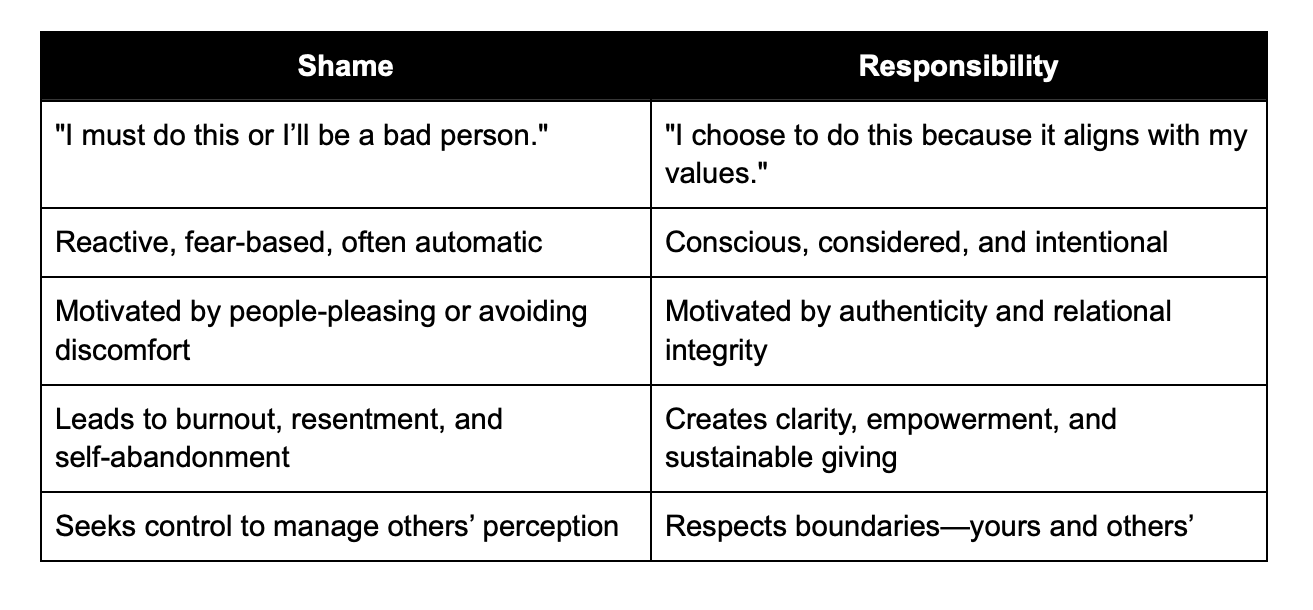
People-Pleasing as Shame Management
If you’re a people-pleaser, you’re not weak or broken—you’re adaptive. At some point, your nervous system learned that pleasing others was a path to connection or survival. Maybe you learned to scan for others’ emotions, anticipating their needs before they spoke. Maybe you grew up in a home where saying no wasn’t an option. Maybe your worth was praised most when you were helpful or quiet.
But while these strategies may have protected you once, they can become barriers to your freedom.
People-pleasing isn’t true responsibility. It’s often an unconscious attempt to control how others see us—to avoid being disliked, disappointing someone, or feeling the discomfort of conflict. It keeps us in performance mode and disconnected from our truth.
Here are some signs that shame is driving your “yes”:
You say yes when your body says no.
You feel like you have to explain or apologize for your needs.
You often feel drained or resentful, but can’t pinpoint why.
You take on others’ discomfort, pain, or urgency as your own.
When we live this way, we abandon ourselves. And without self-connection, true responsibility can’t take root.
Shame or Responsibility? Questions for Reflection
One of the most powerful shifts we can make is learning to pause and ask ourselves: What’s really driving this choice?
Here are some questions to help you begin discerning whether you’re acting from shame or from self-trust:
When I said yes to that request, what was I hoping to avoid?
Am I trying to control how others see me, or genuinely tending to my values?
Do I feel expansive or contracted in my body after that decision?
Am I acting from fear of being “too much” or “not enough”?
What would change if I trusted myself to make a different choice?
What emotion am I avoiding by over-functioning right now?
I encourage you to journal with these questions or sit with them during a quiet moment. Let them work gently, not forcefully. The goal is not to shame yourself further—but to begin cultivating clarity and compassion for your own patterns. When you find yourself in a place of over-responsibility or inner tension, it’s a beautiful invitation to pause and reflect. Your body holds wisdom. Your discomfort often points to the truth.
The Path to Self-Trust: From Managing to Relating
The remedy for shame isn’t more control. If that were the answer, I would have conquered this decades ago. Control was a survival strategy I mastered early. I knew how to organize, over-function, and micromanage every corner of my life in an effort to feel safe. But what that led to—over time—was more blame, more anxiety, and a chronic sense that I could never quite rest.
What I’ve discovered instead is that the path to liberation isn’t paved with control, but with connection.
Self-trust isn’t something we force into being. It’s something we cultivate. Like any meaningful relationship, it requires presence, honesty, and practice. Over the past few years, I’ve learned how to soften. How to rest. How to turn toward myself instead of away. I’ve learned that trust isn’t just a concept—it’s an embodied experience that grows stronger each time I listen to myself and honor what I hear.
Here are a few practices that can help build this inner relationship:
Yoga reconnects us with the truth of our bodies—our boundaries, our needs, our sensations.
Meditation allows us to witness our thoughts and patterns without judgment, building space between reaction and response.
Journaling invites us into dialogue with ourselves, helping us clarify what’s really going on inside.
Nature walks or moments of stillness ground us in something larger than ourselves and remind us that we are already whole.
These aren’t tools for perfection. They’re invitations into presence.
True Responsibility Liberates Us
At The Creatrix, we believe that true transformation begins within. When we begin to untangle shame from responsibility, we reclaim a sacred kind of freedom. We stop living to be perceived a certain way, and start living from the core of who we are. We stop abandoning ourselves in the name of being good—and start showing up for ourselves with grace, trust, and alignment.
Responsibility, when rooted in authenticity, feels lighter, not heavier. It brings peace, not pressure. And it makes space for us to belong to ourselves and to others—fully and freely.
So this week, I invite you to experiment with one simple pause.
Before you say yes—pause.
Ask yourself: Is this coming from shame… or self-trust?
What might shift if you chose to act from a place of inner knowing?
Your body knows. Your spirit knows. And with time, self-trust becomes a steady companion on the path to true liberation.
Dawn Cannon | JUL 7, 2025
Share this blog post

The Creatrix
CONTACT
© 2026 The Creatrix