Welcome to The Creatrix.
The Chakras: Seven Doorways to Understanding Ourselves
Dawn Cannon | OCT 12, 2026
The Chakras: Seven Doorways to Understanding Ourselves
Exploring the ancient wisdom of the chakra system and its invitation to greater self-awareness.

There is so much more to us than what we can see.
We experience life through our physical bodies, but we also experience it through our emotions, our thoughts, our relationships, our choices, and that quiet inner knowing that sometimes seems to emerge from somewhere deeper than the thinking mind. We know what it feels like to be grounded, to feel confident, to experience love, to speak our truth, and to trust ourselves. And we also know what it feels like when those experiences seem far away. Perhaps you've had a season when everything felt uncertain, when you struggled to make decisions, or when you found yourself disconnected from the person you know yourself to be.
What if these experiences weren't entirely separate? What if there were a way to explore the relationship between our physical existence, our emotional lives, our personal power, and our capacity for awareness?
For thousands of years, various traditions of yoga and Indian spiritual philosophy have explored questions about the relationship between body, mind, energy, and consciousness. One of the most fascinating frameworks to emerge from these traditions is the chakra system, a way of understanding the different dimensions of our human experience and the ways they influence one another.
The chakra system has become one of the most meaningful tools in my own journey of self-understanding. What began as an intriguing concept during my early yoga studies has gradually become a framework I return to whenever I feel disconnected, uncertain, or in need of greater clarity. And the longer I work with these teachings, the more I appreciate their invitation to look within, not because something is necessarily wrong, but because there is always more to understand.
What Are the Chakras?
The Sanskrit word chakra translates to "wheel" or "disk." Within yogic subtle-body teachings, chakras are understood as centers of vital energy and consciousness, often represented as spinning wheels or lotus flowers. They are traditionally associated with different aspects of our physical existence, emotional experience, psychological development, and spiritual awareness.
In Wheels of Life, Anodea Judith describes the chakras as organizing centers through which life energy is received, assimilated, and expressed. I find this description especially meaningful because it presents the chakras not simply as seven separate points within the body, but as an interconnected system through which we experience and participate in life. Each chakra represents a different dimension of consciousness, from our most fundamental needs for survival and safety to our capacity for love, creativity, wisdom, and spiritual awareness. Together, they offer a map for exploring the relationship between body, mind, and consciousness.
It is important to understand that the chakras belong to the traditional framework of the subtle body. They are not anatomical structures that modern science has established or measured in the way we study the nervous system or circulatory system. Rather, they are part of a philosophical and experiential understanding of human existence that has developed through centuries of spiritual inquiry and practice. For many practitioners, myself included, this framework offers a meaningful way to examine experiences that can otherwise be difficult to understand or articulate.
There are also several different chakra systems within Indian spiritual traditions, and they do not all describe the same number of chakras, locations, or symbolic relationships. For the purpose of our exploration, we will focus on the familiar seven-chakra model, drawing primarily from Anodea Judith's Wheels of Life and Eastern Body, Western Mind. Judith's work has been particularly influential in contemporary Western yoga because she brings together traditional chakra symbolism and modern psychological perspectives, offering a framework for exploring how our experiences shape our relationship with ourselves and the world.
My Own Journey with the Chakras
Early in my yoga studies, the chakra system was one of those concepts that simply felt right. I couldn't necessarily explain why at the time, but something about the idea that our physical, emotional, and spiritual experiences were deeply interconnected resonated with me. It suggested that the different parts of ourselves were not competing for attention, but were continually influencing and informing one another.
During my 500-hour yoga teacher training, we took a fairly deep dive into the chakra system, and that exploration gave me an entirely new language for understanding myself. I began recognizing connections between my experiences, my emotional responses, my relationships, and the ways I moved through the world. What had once seemed like separate challenges or patterns began to feel connected within a larger picture.
One experience from that training has remained especially memorable. We worked with pendulums, exploring the energy associated with the chakras while practicing with a partner. During that exercise, I experienced something that felt like a tangible encounter with the energy we had been studying. I recognize that pendulum movement can also be influenced by unconscious muscular movement, and I don't offer the experience as scientific proof of the chakra system. But it was meaningful to me. It encouraged me to become more curious about the relationship between what I could observe, what I could feel, and what I might discover through continued practice.
Over the years, the chakra system has become a framework I return to again and again. When I feel out of balance, when my awareness seems diminished, or when I find myself struggling with something in life, I often turn to these teachings. Not because I believe they provide a simple diagnosis or an instant solution, but because they help me ask better questions. Where am I feeling disconnected? What part of my experience needs attention? What patterns might I be repeating? What practices could help me return to a more grounded, compassionate, and authentic relationship with myself?
This process has gradually strengthened something that is central to both my personal practice and my work as a teacher: trust in our own capacity for awareness and understanding. I believe we carry an extraordinary ability to recognize our patterns, discover what supports us, and participate in our own growth. Sometimes what we need most is not another answer from outside ourselves, but a framework that helps us listen more carefully to the wisdom already present within us.
The Chakras and the Practice of Yoga
The chakra system is closely connected to traditions of yoga, particularly those that explore the subtle body, prāṇa, and Kundalini. The word yoga comes from the Sanskrit root yuj, meaning to yoke, join, or unite. Within some yogic philosophies, yoga is understood as a path toward recognizing the relationship between our individual existence and a deeper reality of pure consciousness. Through practices such as movement, breathwork, meditation, self-study, and contemplation, we begin to explore the nature of our experience and our relationship with the world around us.
The chakra system offers one way of understanding this exploration. To appreciate how the chakras are traditionally understood to function, it helps to become familiar with three foundational concepts: prāṇa, nāḍīs, and chakras themselves.
Prāṇa is often translated as vital life force, the animating energy understood within yogic philosophy to sustain life. Nāḍīsare the subtle pathways through which prāṇa is traditionally described as moving. The chakras are understood as centers within this subtle network, associated with particular qualities of energy and consciousness. Together, these concepts form a philosophical and experiential framework rather than a scientifically verified map of the body's physical structures.
Within this framework, the chakras are understood as constantly interacting. We cannot truly separate our emotions from our physical experience, our sense of personal power from our relationships, or our thoughts from the way we move through the world. Likewise, the chakras are understood as a living, interconnected system. We may study them individually to better understand their particular qualities, but their relationship to one another is essential to understanding the whole.
The Three Principal Nāḍīs: Suṣumṇā, Iḍā, and Piṅgalā
Within certain yogic traditions, three subtle channels are considered especially important. Suṣumṇā is described as the central channel, extending along the body's central axis. It is particularly significant in Kundalini teachings, where it is associated with the movement of spiritual energy and the process of awakening. Iḍā is traditionally associated with lunar qualities such as cooling, receptivity, and inward awareness, while Piṅgalā is associated with solar qualities such as warmth, activity, and outward expression.
Iḍā and Piṅgalā are often depicted as winding pathways moving in relationship to the central channel, though their exact representation varies across traditional texts. Together, these channels offer a way of contemplating complementary qualities within our experience: rest and action, receptivity and expression, stillness and movement. Rather than viewing these qualities as opposites in conflict, yoga invites us to consider how they might exist in relationship with one another.
I find this especially helpful when thinking about balance. We sometimes imagine balance as a fixed state, a place where everything in our lives is finally settled and nothing is pulling us in competing directions. But life rarely works that way. Perhaps balance is less about achieving a perfectly still center and more about developing the awareness and flexibility to respond to the changing circumstances of our lives.
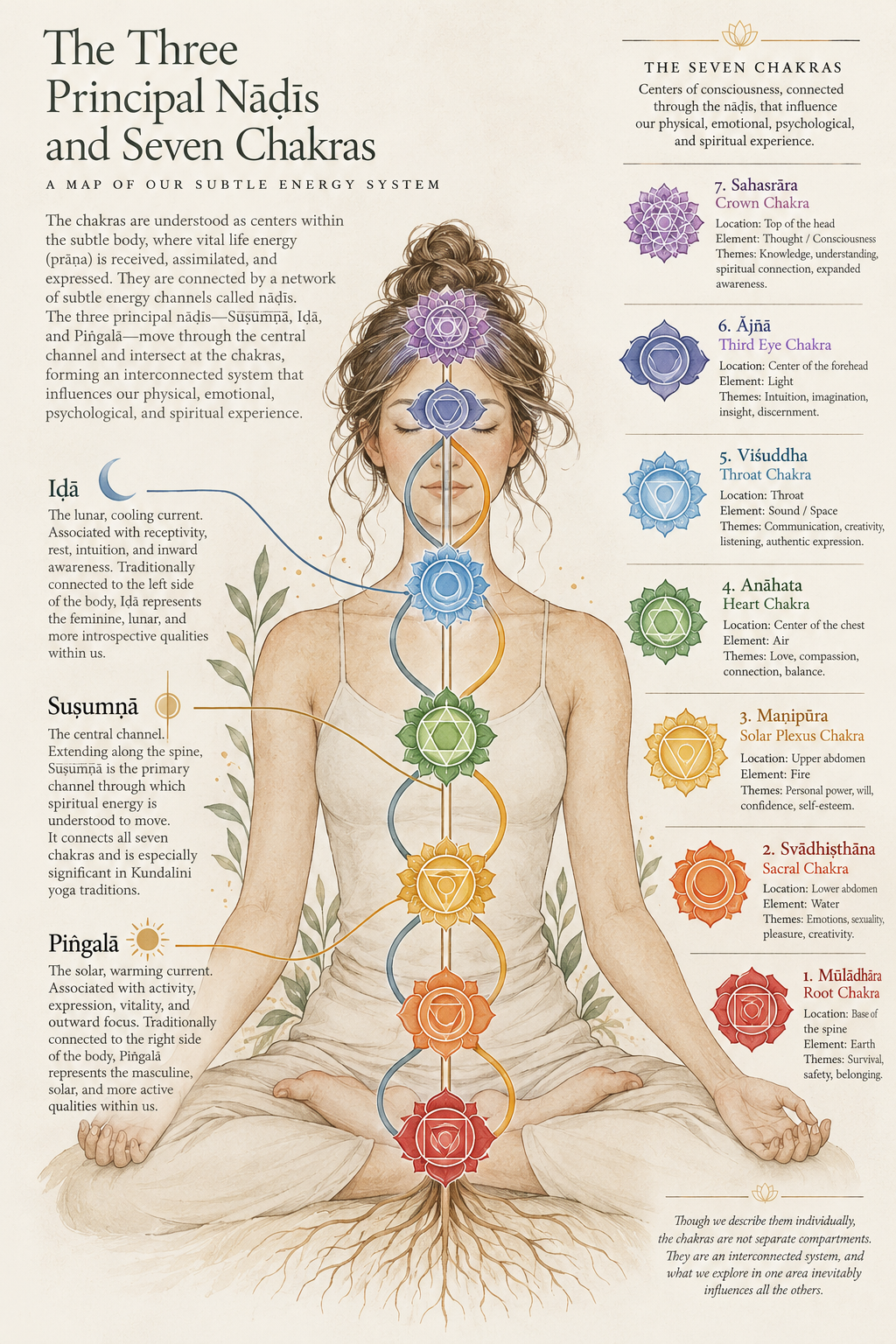 Creatrix illustration: The Three Principal Nāḍīs and Seven Chakras
Seven Centers of Human Experience
In the seven-chakra model, each chakra is associated with a particular location, element, and dimension of consciousness. Although the associations vary across traditions, the following descriptions reflect the modern framework we will be exploring throughout this series.
Mūlādhāra, the Root Chakra, is located at the base of the spine and associated with the element of earth. It represents our relationship with survival, stability, safety, and belonging. Through this chakra, we explore our connection to the physical world, our fundamental needs, and the support that allows us to feel grounded in our lives.
Svādhiṣṭhāna, the Sacral Chakra, is located in the lower abdomen and associated with water. It represents emotions, sexuality, pleasure, and creativity. Its teachings invite us to explore our capacity to feel, experience joy, and move with the changing currents of life rather than attempting to control every experience.
Maṇipūra, the Solar Plexus Chakra, is located in the upper abdomen and associated with fire. It represents personal power, will, confidence, and self-esteem. Through this chakra, we examine our relationship with choice, boundaries, and purposeful action, including our capacity to participate actively in shaping our lives.
Anāhata, the Heart Chakra, is located at the center of the chest and associated with air. It represents love, compassion, connection, and balance. Its teachings invite us to explore how we give and receive love, how we relate to others, and how we extend compassion toward ourselves.
Viśuddha, the Throat Chakra, is located at the throat and associated with sound and space. It represents communication, creativity, listening, and authentic expression. Through this chakra, we consider how we speak our truth, how we listen to others, and how we make room for honest expression in our relationships.
Ājñā, the Third Eye Chakra, is associated with the center of the forehead and the element of light. It represents intuition, imagination, insight, and discernment. Its teachings invite us to look beyond our habitual assumptions, question the stories we tell ourselves, and cultivate clearer perception.
Sahasrāra, the Crown Chakra, is associated with the top of the head and, within this modern framework, thought and consciousness. It represents wisdom, understanding, spiritual connection, and expanded awareness. Through this chakra, we explore our relationship with meaning, the nature of consciousness, and the mystery of existence.
Although we describe these seven centers individually, they are not separate compartments within us. Each is understood in relationship to the others. Our ability to express ourselves may be influenced by our sense of safety. Our confidence may be shaped by our emotional experiences. Our capacity for connection may be affected by how we understand and care for ourselves. When we begin exploring one dimension of our experience, we inevitably encounter others, because the different aspects of our lives are continually informing and influencing one another.
Two Currents: Liberation and Manifestation
One of the teachings I find especially beautiful in Anodea Judith's work is the relationship between two complementary currents within the chakra system: the liberating current and the manifesting current.
The liberating current is represented as moving upward, from the Root Chakra toward the Crown. It symbolizes movement from the density of physical existence and individual identity toward greater awareness, freedom, and expanded consciousness. As we move through the symbolic qualities of the chakras, we begin with our most fundamental relationship to physical survival and gradually explore increasingly expansive dimensions of human experience, including love, expression, intuition, and spiritual understanding.
The manifesting current moves in the opposite direction, from the Crown Chakra toward the Root. It represents the movement of consciousness into form, bringing awareness, intention, and possibility into our physical lives. Through this current, what begins as insight or understanding becomes something we can express through our choices, relationships, creativity, and actions.
These two currents offer a beautiful way to understand the relationship between spiritual awareness and everyday living. We seek to expand our consciousness, but we also seek to embody what we discover. We move inward to understand ourselves more deeply, and then we bring that understanding outward through the ways we participate in the world.
Within Hindu and tantric traditions, the relationship between Shiva and Shakti offers another lens through which to contemplate consciousness and creative power. In some philosophical interpretations, Shiva represents pure consciousness, while Shakti represents the dynamic power through which consciousness manifests and expresses itself. Their relationship is complex and understood differently across traditions, but the symbolism invites us to consider how awareness and creative energy belong together.
For me, this is where the teaching becomes especially meaningful. Yoga is not simply about transcending our human experience or finding a way to rise above the difficulties of everyday life. It is also about becoming more fully present within that life. What good is the wisdom we discover in meditation if we cannot bring it into our relationships, our choices, our work, and the ordinary moments that make up our days? We move inward to understand, and we bring that understanding outward through the way we live.
 Creatrix illustration: The Liberating and Manifesting Currents
What Happens When We Feel Out of Balance?
In Eastern Body, Western Mind, Anodea Judith explores the chakra system through the lens of psychological development and human experience. Within this framework, chakra patterns may be described as deficient, excessive, or more balanced. A deficient pattern might represent qualities that feel difficult to access or express, while an excessive pattern might represent qualities that have become overemphasized or rigid. Balance, in this understanding, represents a greater capacity for flexibility, responsiveness, and integration.
For example, when exploring the Solar Plexus Chakra, which is associated with personal power and self-esteem, we might begin reflecting on our relationship with choice and agency. Do I struggle to make decisions? Do I have difficulty expressing my boundaries? Do I sometimes attempt to control situations because uncertainty feels uncomfortable? These questions do not establish that something is wrong with our Solar Plexus Chakra. Rather, they invite us to examine patterns that may deserve our attention.
This is one of the ways I have found the chakra system most useful in my own life. When something feels difficult, my first instinct can sometimes be to figure out how to change it. But the chakra teachings invite me to begin somewhere else, with curiosity. What is happening within me? What might this experience be asking me to notice? What beliefs, habits, or experiences might be influencing the way I am responding? And what support or practice might help me move toward a more balanced relationship with myself?
The chakra system becomes less about identifying something broken and more about developing a compassionate relationship with the whole of ourselves. It gives us a way to explore our patterns without immediately judging them, and it reminds us that awareness itself can be an important beginning.
Working with the Chakras Is an Ongoing Practice
One thing I hope to communicate throughout this series is that working with the chakras is not something we simply do once, fix, and forget. We are living, changing beings. Our relationships evolve, our circumstances shift, and we move through experiences of joy, grief, uncertainty, growth, and transformation. As our lives change, the ways we relate to ourselves change as well.
Within chakra traditions and contemporary chakra-based practices, people may explore these themes through yoga postures, breathwork, meditation, mantra, movement, creative expression, contemplation, and everyday life experiences. Sometimes the practice may be as simple as standing with our feet on the ground and noticing the support beneath us. Sometimes it might mean allowing ourselves to feel an emotion without immediately trying to change it. At other times, the practice might involve having a difficult conversation, setting a boundary, making room for creativity, or sitting quietly long enough to recognize what is happening within us.
I have come to believe that the more we practice awareness, the more we begin to recognize our capacity to participate in our own growth. Not because we can control everything that happens to us, and certainly not because every difficulty can be resolved through energy work, but because awareness creates possibilities. We begin to recognize patterns that previously operated outside our conscious attention. We discover that we may have more choices than we initially believed. We learn which practices help us feel supported, connected, and capable of responding to life with greater intention.
And gradually, through this ongoing process of exploration, we may develop a deeper sense of trust in ourselves. For me, this is one of the greatest gifts of studying the chakras. The teachings have not provided a way to avoid life's difficulties, but they have offered a way to meet those difficulties with greater curiosity, understanding, and compassion. There is an extraordinary kind of personal freedom that comes from recognizing that we can participate in our own healing and growth, even when we cannot control the circumstances surrounding us.
Seven Doorways, One Journey Inward
Over the next four weeks, I'll be exploring the seven chakras here at The Creatrix. We'll look at the symbolism and teachings associated with each center, but we won't stop with intellectual understanding. We'll also explore yoga practices, meditation, breathwork, creative activities, and reflective questions that invite us to bring these teachings into our everyday lives.
We'll begin with the Root Chakra and the experience of grounding, safety, and belonging. From there, we'll explore creativity, personal power, compassion, communication, intuition, and awareness. Each week will offer opportunities to learn about the chakra system while also reflecting on how these themes appear within our own experiences.
My hope is not that you'll finish this journey believing you've perfected or balanced all seven chakras. Rather, I hope you'll come away with a deeper understanding of yourself, a few practices that help you reconnect when life feels difficult, and perhaps a greater willingness to approach your experiences with curiosity instead of judgment.
Most importantly, I hope this exploration encourages you to trust the wisdom already present within you. Because the chakra system, for me, is ultimately not about becoming someone else. It is about discovering more of who we already are and learning to live with greater awareness, compassion, and intention.
What might become possible if you approached yourself not as something to fix, but as someone worthy of deeper understanding?
I invite you to join me over these next four weeks as we explore seven doorways into the extraordinary experience of being human. Subscribe to The Creatrix newsletter for weekly teachings, reflective questions, and practices to support your journey inward.
Where Rest Becomes Clarity. Trust Leads the Way.
Primary Reading and Inspiration
Anodea Judith, Wheels of Life: The Classic Guide to the Chakra System.
Anodea Judith, Eastern Body, Western Mind: Psychology and the Chakra System as a Path to the Self.
The explanations of chakra themes, psychological patterns, and the liberating and manifesting currents are informed by Judith's interpretive framework. Personal reflections and invitations to practice are my own.
Dawn Cannon | OCT 12, 2026
Share this blog post

The Creatrix
CONTACT
© 2026 The Creatrix