Welcome to The Creatrix.
Threshold Moments: Standing in the Doorway
Dawn Cannon | AUG 18, 2026
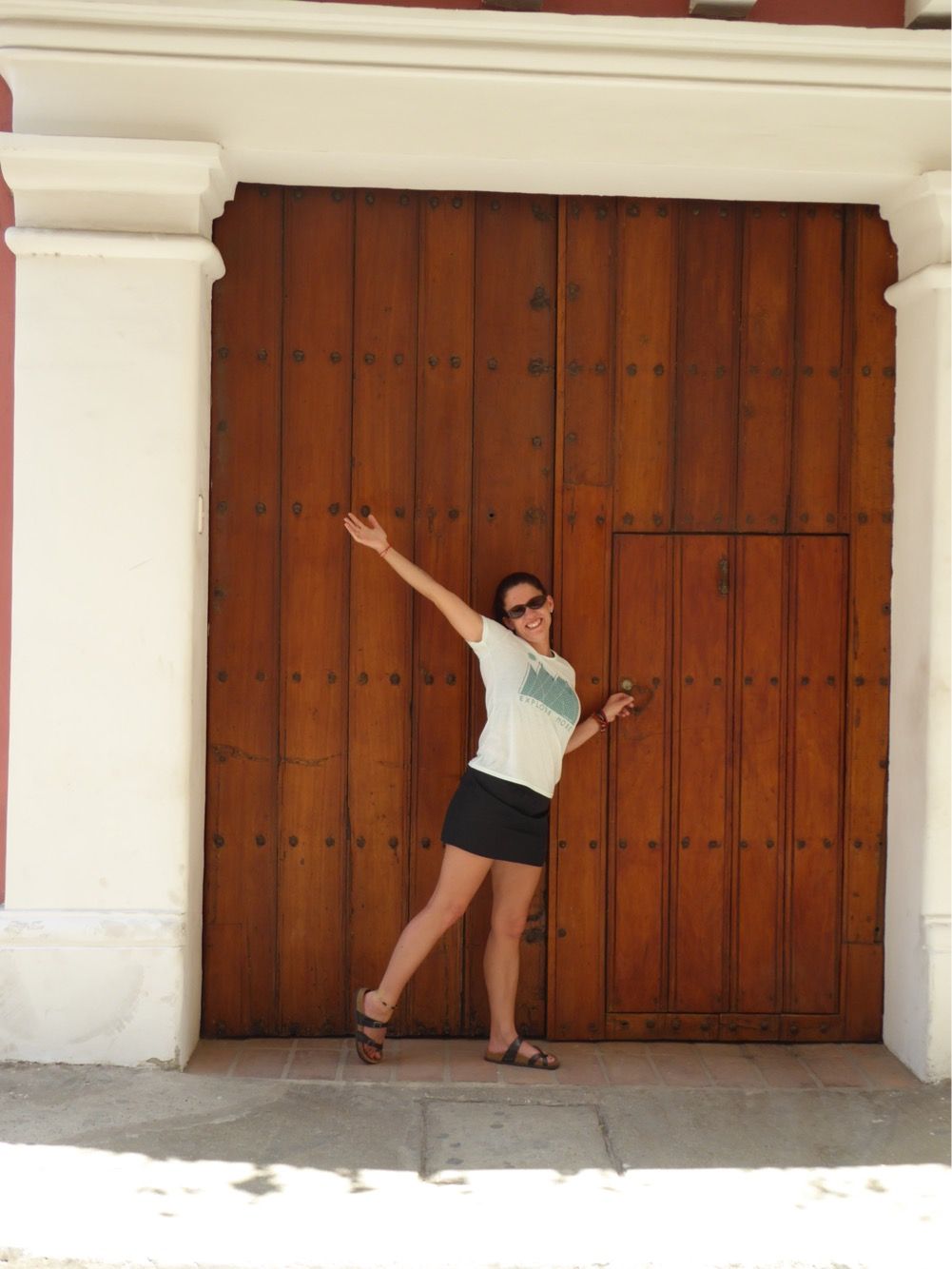
I didn't know it at the time, but this photograph was taken at a threshold.
I was in Colombia several years ago, and I had recently begun my yoga teacher training. I remember being fascinated by this enormous wooden doorway and being encouraged to pose in front of it for a picture.
Looking at the photograph now, I see something I couldn't have known then. I was standing at the beginning of a journey that would change the shape of my life. I didn't know where that path would lead. I didn't know that years later I would leave my corporate career, build The Creatrix, teach yoga and meditation, and eventually create my own 200-hour yoga teacher training program.
I simply knew that I was standing in a doorway. And perhaps that's how most thresholds work. We rarely understand their significance while we're standing in them.
There is something about standing in a doorway that feels different from simply walking through one. For a moment, you are suspended between two spaces. Behind you is the room you know: the familiar light, the familiar sounds, the objects and routines that have become so ordinary that you hardly notice them anymore. In front of you is another space. You may be able to see into it, but you cannot see everything. You don't quite know what it will feel like to live there.
There is often a small pause before the next step. A hand resting against the doorframe. A breath that catches for just a moment. An awareness that once you move forward, you will be standing somewhere different.
You are at a threshold.
We encounter these moments throughout our lives. Some are obvious and celebrated: graduating from high school, leaving one career and beginning another, starting college or a training program, getting married, becoming a parent, moving to a new place.
Others happen quietly, sometimes without anyone else knowing that something significant has shifted. We decide to leave an unhealthy habit behind. We begin the creative project we've been carrying for years. We finally say no to something that has been draining us. We recognize that a relationship, a role, or a way of living no longer fits who we are becoming.
Some thresholds are chosen. Others are placed in front of us by circumstances we never would have chosen.
But all of them have something in common: Life is changing.
Something about the way we have known ourselves or our lives is coming to an end, and something new is beginning to take shape.
We don't always stop to acknowledge these moments.
Our culture is remarkably good at teaching us to move on quickly. We finish one chapter and immediately begin planning the next. We graduate high school and start worrying about college. We leave one job and begin proving ourselves in the next. We accomplish something we've worked toward for years and almost immediately ask, What's next?
Even our celebrations can sometimes become hurried transitions.
But there is something valuable in the space between. The life we knew may no longer fit quite the same way, but the shape of what comes next hasn't fully formed.
That in-between space can feel uncomfortable because it asks us to live without the certainty of what was or the reassurance of what will be.
And perhaps that is precisely why it deserves our attention.
This is part of what I believe so deeply about the work we do at The Creatrix: healing begins when we become fully available to the moment we are actually living. Transformation doesn't have to be forced. Sometimes it unfolds simply because we finally become quiet enough to notice what is already changing within us.
Instead of rushing toward the other side, we can pause long enough to notice where we actually are.
We can look back.
We can look forward.
And we can simply stand in the doorway for a while.
What we carry with us
One of the things I find most beautiful about thresholds is that they often contain both joy and grief. We don't talk about this very often.
Graduation can be exciting and bittersweet. Starting a new job can feel exhilarating while also bringing sadness about the people and routines we are leaving behind. Becoming a parent can be filled with wonder while asking us to release an identity and a way of living that we once knew.
Even when we are the ones choosing the change, there can be grief. I think we sometimes make the mistake of believing that if we are ready to move forward, we shouldn't look backward. But perhaps compassion asks something different of us.
We can honor where we've been without needing to return there. We can feel tenderness toward an earlier version of ourselves without deciding that we should have made different choices. We can acknowledge that a habit no longer serves us while still having compassion for the person who once needed it.
Nothing within us needs to be exiled.
Perhaps standing at a threshold is an opportunity to gather ourselves gently before we move forward—to thank the parts of us that helped us get here, even if we don't intend to take all of them with us.
Some things we carry forward.
Some things we set down.
And sometimes we don't know which is which until we take the time to listen.
Making room for the unknown
There is another quality I hope we remember at thresholds: wonder.
The unknown can make us uncomfortable. We want to know what will happen before we are willing to take the next step. We want reassurance that we've made the right decision. We want to know that the doorway we're walking through will lead somewhere better.
But life rarely offers that kind of certainty.
What if, instead of demanding certainty, we allowed ourselves a little curiosity?
What might become possible here?
What might I discover about myself?
What is waiting to emerge that I cannot see yet?
There is a particular beauty in not knowing. It allows us to become students of our own lives. Wonder invites us to look again at what we thought we already understood.
A doorway is just a doorway: wood, hinges, a frame, a threshold worn smooth by footsteps. And yet, when we recognize what it represents, something ordinary becomes sacred.
Perhaps this is what it means to practice wonder—to slow down enough to notice that there is more here than we first saw.
Choosing what we stand for
Interestingly, I experienced another threshold this weekend when I became an honorary member of Phi Chi Theta, a professional fraternity whose values include leadership, community, service, professionalism, diversity, and personal and professional development.
The ceremony was meaningful to me because becoming part of a community is more than being welcomed into a room. It carries a sense of commitment. It asks us to consider not only where we are going, but how we intend to walk once we get there. That feels important.
Thresholds aren't only about what we are becoming. They are also opportunities to decide what we will stand for.
Thresholds aren't only about what we are becoming. They are also opportunities to decide what we will stand for and how we want to walk once we arrive on the other side. What values do we want to carry with us? What do we want our presence to contribute to the communities we enter?
These questions feel especially meaningful to me right now.
This Friday, I will stand at another doorway. The image of that younger version of me standing in the doorway in Colombia feels especially meaningful now.
This time, I won't be the student beginning a yoga teacher training. I'll be the teacher welcoming students into one. And I know now that I don't need to know exactly where this doorway will lead, either. I only need to be present enough to step through it with them.
For my students, this is the beginning of a significant journey. They are entering a deeper study of yoga, but I hope they discover that the journey is ultimately about much more than learning how to teach poses. They are stepping into a new relationship with themselves. They will be invited to listen more closely to their bodies, their minds, their patterns, their stories, and the wisdom that lives beneath all of that noise.
For me, this threshold is significant, too. I have spent years teaching yoga, meditation, and Yoga Nidra and creating spaces where people can slow down enough to hear themselves again. Now I am stepping into a different kind of role: helping develop teachers who will carry these practices into their own lives, communities, and classrooms.
There is excitement, certainly. There is gratitude. And there is a tenderness to it that I didn't quite expect. I have spent years learning how to hold space for people in my classes. Now I am being asked to hold space for people who are learning how to hold space for others.
That feels both deeply meaningful and deeply humbling.
I don't think I would want to enter this threshold without feeling a little bit of that weight.
It reminds me that something important is happening here.
Why ceremony matters
I have intentionally built ceremony into our first weekend together because I believe we lose something when we rush past our thresholds. Ceremony doesn't have to be elaborate. It doesn't require a particular religion or tradition.
Sometimes ceremony is simply the act of saying: This matters. I want to remember this moment. We don't need elaborate rituals to mark a threshold. Sometimes the ceremony is simply the willingness to stop long enough to acknowledge that our lives are changing.
Before we dive into anatomy, philosophy, sequencing, teaching skills, and all the things that make up a 200-hour training, we will pause. We will acknowledge where we have each come from. We will honor what brought us into the room. We will make space for what we are carrying and what we hope to discover. And then, together, we will step across the threshold.
Because I don't want this training to simply mark the beginning of a program. I want it to mark the beginning of a new chapter in each person's relationship with themselves.
As I prepare to welcome my first group of Pathways to Peace students this Friday, I find myself thinking about all the doorways we pass through during a lifetime. Some are celebrated with flowers and photographs and people gathered around us. Others happen quietly, perhaps in the privacy of our own homes, when something inside us says, I can't keep doing this the way I've been doing it.
Maybe you are standing at one of those doorways now. Perhaps you are beginning something new. Perhaps you are letting something go. Perhaps you are somewhere in the middle, where the old way of living no longer quite fits but the new way hasn't revealed itself yet.
If so, you don't have to rush through. Pause for a moment. Notice what is behind you. Honor what it has given you. Be gentle with the parts of yourself that are still catching up to the change. Then turn toward the doorway.
You may not be able to see very far into the next room. You may not know exactly what waits for you there. But perhaps you don't need to. Perhaps you only need to bring your full attention to this moment, a little tenderness for what has been, curiosity about what might become, and enough trust to take the next step.
We don't have to know exactly what waits on the other side.
We only need to be willing to meet it.
Perhaps that is what a threshold asks of us—not to become someone new, but to become more fully available to the person we already are.
To pause.
To listen.
And then, when the moment comes, to step through.
Where Rest Becomes Clarity. Trust Leads the Way.

Dawn Cannon | AUG 18, 2026
Share this blog post

The Creatrix
CONTACT
© 2026 The Creatrix