Welcome to The Creatrix.
When Rest Becomes the Rhythm That Carries You
Dawn Cannon | JAN 12
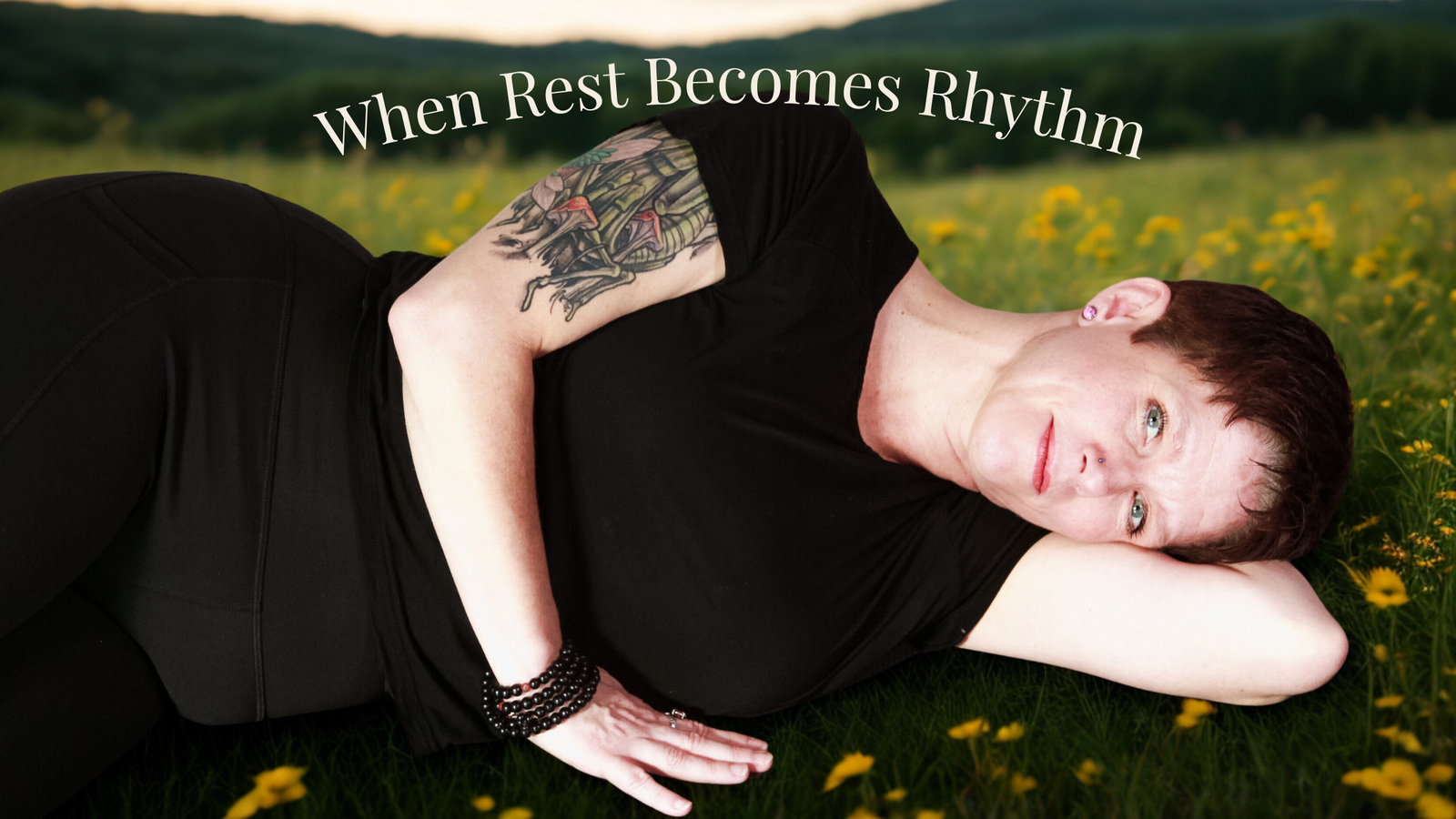
There comes a moment—often quietly—when rest is no longer enough on its own.
Not because it failed you.
Not because you did it wrong.
But because rest was never meant to be the destination.
It was meant to be the ground.
Many of us arrive here in mid-winter standing at the edge of two familiar extremes. On one side is relentless motion: the constant doing, striving, and pushing forward even when the body whispers please slow down. On the other side is a heaviness that can settle in after long seasons of depletion—rest that turns stagnant, motivation that feels distant, energy that never quite returns.
Both are honest places. Both are protective responses. And neither is where we are meant to live forever.
What we are actually longing for is rhythm.
The Two Ways We Lose Our Way
Some of us live in over-effort. We know how to move, how to achieve, how to keep going—but we’ve forgotten how to stop without guilt. Rest feels unsafe or unproductive. Stillness brings discomfort. The nervous system stays alert, scanning for what comes next.
Others find themselves in under-effort. Not from laziness, but from exhaustion that runs deep. Rest no longer feels nourishing. The body feels heavy. The spark that once pulled us toward life feels dim, buried under layers of overwhelm or grief.
Both states are signals. The body is always communicating.
Over-effort says: I don’t trust that I’m safe if I stop.
Under-effort says: I don’t trust that movement will be met with support.
Neither needs fixing. Both need listening.
How Yoga Nidra Changed the Way I Understand Rest
This understanding didn’t come from theory alone—it came from practice.
My relationship with rest shifted most profoundly when I deepened my practice of Yoga Nidra.
At first, it met me in a season of deep exhaustion. I didn’t need motivation or inspiration—I needed my nervous system to feel safe enough to let go. Yoga Nidra offered that. It gave me permission to rest without effort, without performance, without needing to improve anything about myself.
But something unexpected happened as I practiced regularly.
Rest began to sharpen my awareness.
In the stillness of Yoga Nidra, I started to notice subtle cues I had long overridden—the way my body responded to certain commitments, the quiet signals of readiness or resistance, the difference between true fatigue and the kind of heaviness that comes from staying still for too long.
Rest wasn’t making me passive.
It was making me more honest.
Over time, Yoga Nidra became more than a recovery tool. It became a way of listening. A practice of returning to awareness itself—where clarity arises not because we search for answers, but because the noise finally settles enough for truth to be felt.
This is when my teaching path clarified.
I realized that intentional rest doesn’t pull us away from our lives—it prepares us to meet them with discernment. From that place, movement becomes responsive instead of reactive. Vision arises without force. Action feels aligned rather than driven.
Yoga Nidra taught me that rest is not an end point.
It is a threshold.
And when we learn to rest with awareness, we don’t lose momentum—we find rhythm.
How to Recognize Where You Are
You might be leaning toward over-effort if:
You feel restless or anxious when you try to rest
You need distraction to relax
Your breath is shallow or frequently held
Even joyful things feel like work
You might be leaning toward under-effort if:
You feel foggy, unmotivated, or numb
Rest doesn’t leave you feeling restored
Your body feels heavy or disconnected
Starting feels harder than continuing
Balance feels different. In balance:
Rest leaves you clearer, not dulled
Movement brings energy rather than depletion
You can pause without fear
You feel choice instead of compulsion
This balance doesn’t live in someone else’s routine.
It lives in your body.
Rest Is Not the Opposite of Movement
We often treat rest and action as opposites—one good, the other bad. But in the body, they are part of the same cycle. Rest prepares us to rise. Movement allows us to integrate what rest reveals.
True rest doesn’t collapse us.
True movement doesn’t exhaust us.
When rest becomes intentional—when it is chosen rather than forced—it begins to create rhythm. And rhythm carries us forward with far less effort than willpower ever could.
Support for the Over-Efforter
If you tend to push, your nervous system may need reassurance before it can soften. Here are some ideas for breath, yoga, meditation and journaling to help support you finding balance between effort and ease.
Breath
Try extending your exhale: inhale for four counts, exhale for six. Let the exhale be a signal of safety.
Gentle Yoga
Supported Child’s Pose, Legs Up the Wall, or a slow supine twist can invite the body to settle without shutting down.
Meditation
Choose body-based awareness rather than visualization. Notice sensation. Notice contact with the ground. There is nothing to achieve here.
Journaling
What do I fear would happen if I truly slowed down?
When did I learn that rest was not safe or allowed?
Where in my life am I already being held without effort?
Support for the Under-Efforter
If energy feels distant, the body may be asking for gentle activation—not pressure. Here are some ideas for breath, yoga, meditation and journaling to help support you finding balance between effort and ease.
Breath
Three-part breathing (belly, ribs, chest) can awaken vitality. Add a soft pause after the inhale.
Gentle Yoga
Seated side bends, slow sun salutations, or standing poses that invite light effort can rekindle aliveness.
Meditation
Try meditating with eyes open, grounded in sensation rather than seeking calm. Presence often comes before motivation.
Journaling
What feels heavy—and what feels empty?
What kind of movement actually gives me energy?
What is one small action that feels kind rather than demanding?
Balance Is Personal
What feels like rest for one person may feel like stagnation for another. What feels like healthy effort for one body may feel overwhelming for another.
There is no universal formula.
The question is not how much should I be doing?
The question is how does my body feel afterward?
Does rest leave you more available to life?
Does movement leave you more at home in yourself?
When Rest Becomes Rhythm
When rest and movement begin to speak to one another, something shifts. Clarity starts to arise naturally. Vision stops feeling forced. The next step reveals itself not through urgency, but through readiness.
Rest was never meant to remove you from life.
It was meant to return you to it.
This is the quiet transition many of us are feeling now—the movement from deep rest into intentional rhythm. Not rushing. Not collapsing. Simply listening closely enough to move when the body says yes.
As you move through this week, consider asking yourself:
What does balanced energy feel like in my body—today?
Let that answer change. Let it be honest. And trust that when rest becomes rhythm, it will carry you exactly where you’re meant to go.
Dawn Cannon | JAN 12
Share this blog post

The Creatrix
CONTACT
© 2026 The Creatrix